Employee turnover is one of those problems that can quietly drain a company.
At first, it may look like one person leaving. Then another. Then a whole team starts feeling unstable. Managers spend more time replacing people than developing them. HR teams are stuck restarting the hiring process again and again. Employees who stay behind feel tired, overloaded, and unsure about what is happening.
By 2026, reducing employee turnover is not just about offering a better salary or adding a few extra benefits. Employees want growth, flexibility, clear communication, strong managers, fair treatment, and a work environment that does not burn them out.
For HR teams and managers, this means employee retention needs to be treated as a full strategy, not a last-minute reaction when someone resigns.
What Is Employee Turnover?
Employee turnover is the rate at which employees leave a company and are replaced by new employees.
Turnover can be voluntary or involuntary.
Voluntary turnover happens when employees choose to leave. This could be because of better opportunities, poor management, low pay, lack of growth, burnout, or a weak workplace culture.
Involuntary turnover happens when the company ends the employment relationship. This could be due to performance issues, restructuring, layoffs, or role changes.
For most teams, voluntary turnover is the bigger concern because it often shows that employees are choosing to leave for reasons the company may be able to fix.
Why Employee Turnover Matters in 2026
Employee turnover is expensive, but the cost is not only financial.
Yes, companies spend money on recruitment, job ads, interviews, onboarding, and training. But turnover also affects productivity, team morale, customer experience, and company culture.
When good employees leave, they take knowledge with them. Their teammates may have to cover extra work. Managers may lose momentum. New hires may need months before they fully settle into the role.
And when turnover becomes common, employees start wondering, “Should I leave too?”
That is why reducing employee turnover in 2026 is not just an HR goal. It is a business priority.
Companies that retain employees have more stable teams, stronger performance, better culture, and lower hiring pressure.
Why Employees Leave Their Jobs
Before HR can reduce employee turnover, they need to understand why employees are leaving in the first place.
Employees leave for many reasons, but some of the most common ones include poor management, lack of career growth, low pay, burnout, unclear expectations, lack of recognition, toxic culture, limited flexibility, and better opportunities elsewhere.
Sometimes employees leave because of one major issue. Other times, it is a buildup of small frustrations.
For example, an employee may not quit just because they had one stressful week. But they may quit after months of unclear feedback, heavy workloads, no growth opportunities, and a manager who never checks in.
Turnover usually tells a story. HR and management’s job is to listen closely enough to understand it.
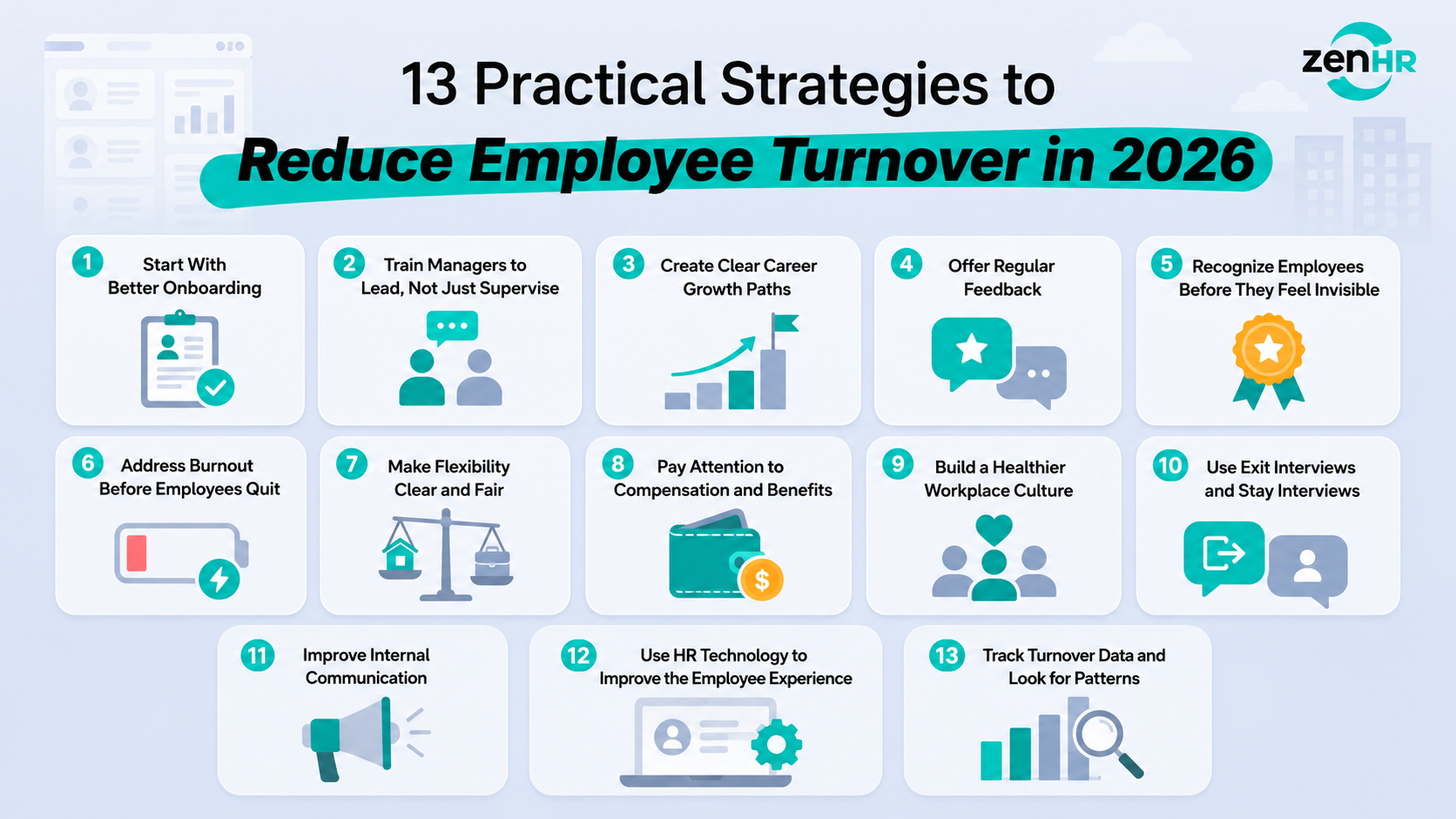
13 Ways to Reduce Employee Turnover
1. Start With Better Onboarding
Employee retention starts before the employee’s first day.
A poor onboarding experience can make new hires question their decision almost immediately. If they do not know what to do, who to speak to, or what is expected from them, they may feel lost from the beginning.
Good onboarding helps employees feel welcomed, prepared, and connected.
A strong onboarding process should introduce the company culture, explain the employee’s role clearly, help them meet key people, provide access to tools and systems, and give them a clear plan for their first few weeks.
Real-life example
Imagine a new sales employee joining a real estate company. On their first day, no one has prepared their laptop, they do not know which projects they are assigned to, and their manager is too busy to meet them.
Now compare that to a company that sends a welcome email before the first day, gives the employee access to the HR system, assigns a buddy, prepares a 30-day plan, and schedules check-ins with the manager.
The second employee is much more likely to feel confident and stay longer.
What HR can do
HR teams should make onboarding structured, simple, and consistent. Use checklists, automated reminders, clear documents, and manager follow-ups to make sure every new hire gets a smooth start.
2. Train Managers to Lead, Not Just Supervise
One of the biggest reasons employees leave is poor management.
People may join a company because of the brand, salary, or opportunity, but they often leave because of their manager.
A manager who communicates poorly, ignores concerns, micromanages, shows favoritism, or gives unclear feedback can quickly push employees away.
In 2026, manager training should be a major part of any employee retention strategy.
Managers need to know how to give feedback, support employees, manage workloads, handle conflict, recognize good work, and have honest conversations.
Real-life example
A customer support team has high turnover. HR reviews the exit interviews and notices the same pattern: employees feel unsupported by their team leader.
The company does not need to immediately increase salaries or redesign the whole department. The first step is to coach the manager, review the team’s workload, and create regular one-on-one check-ins.
Sometimes, improving one manager can improve retention across an entire team.
What HR can do
HR teams should not assume managers automatically know how to lead people. Offer manager training, collect employee feedback about management quality, and include leadership behavior in performance evaluations.
A high-performing manager should not only hit targets. They should also build a team people want to stay in.
3. Create Clear Career Growth Paths
One of the top reasons employees leave is because they do not see a future inside the company.
Employees want to know where they are going. They want to understand what skills they need, what opportunities are available, and how they can grow.
If career growth feels unclear, employees may start looking outside the company for their next step.
This is especially important for younger employees and high performers. They do not want to feel stuck.
Real-life example
A marketing executive has been doing great work for two years. They ask about growth, but their manager keeps saying, “We’ll see later.”
After a while, the employee receives an offer from another company with a clearer title, better responsibilities, and a visible career path. They leave.
The issue was not only money. The issue was uncertainty.
What HR can do
HR teams should create clear career paths where possible. Employees should understand what growth looks like in their department.
This can include internal promotions, skills-based development plans, mentorship programs, learning budgets, leadership training, and internal job openings.
Even if a promotion is not available immediately, employees should still know what they are working toward.
4. Offer Regular Feedback
Annual performance reviews are not enough anymore.
Employees want regular feedback. They want to know how they are doing, what they can improve, and what success looks like.
When feedback is missing, employees may feel confused or undervalued. When feedback only happens after a mistake, employees may feel criticized instead of supported.
Regular feedback helps employees improve before small problems become big ones.
Real-life example
A software developer is missing deadlines, but no one talks to them about it for months. Then, during the annual review, they receive negative feedback and feel shocked.
A better approach would be regular check-ins where the manager discusses workload, blockers, expectations, and support. Feedback should not be a surprise.
What HR can do
Encourage managers to have monthly or quarterly check-ins. These conversations do not need to be long or formal. They just need to be consistent and useful.
HR can also use performance management tools to help managers track goals, document feedback, and support employee development.
5. Recognize Employees Before They Feel Invisible
Employees want to feel that their work matters.
When people work hard but never receive recognition, they may start feeling invisible. And when employees feel invisible, they are more likely to disengage or leave.
Recognition does not always have to be financial. A simple thank you, public appreciation, growth opportunity, or manager acknowledgment can make a big difference.
Real-life example
In a retail company, one employee always helps train new joiners, covers busy shifts, and supports the team. But they are never recognized because their work is “expected.”
Eventually, they leave for a company that notices and appreciates their effort. Recognition helps employees feel valued before they start looking elsewhere.
What HR can do
Build a recognition culture. Encourage managers to notice good work regularly. Create employee recognition programs that highlight teamwork, company values, performance, innovation, and support.
Recognition should not only go to the loudest people or highest-ranking employees. It should also include the people who quietly keep things running.
6. Address Burnout Before Employees Quit
Burnout is one of the biggest turnover risks.
Employees may love their job and still leave because they are exhausted.
Burnout happens when people face constant pressure, unrealistic workloads, lack of support, and no real time to recover.
In 2026, companies cannot treat burnout as a personal weakness. It is often a workplace design problem.
Real-life example
A payroll team works late every month because the payroll process is manual, approvals are delayed, and data is scattered across different systems.
The company may think the team is “dedicated,” but the employees may feel overwhelmed and frustrated. Eventually, they may leave because the workload is not sustainable.
What HR can do
HR teams should look at workload patterns, overtime, absenteeism, manager behavior, and employee feedback.
Ask questions like:
Are employees constantly working after hours?
Are teams understaffed?
Are deadlines realistic?
Are managers encouraging healthy work habits?
Are manual processes creating unnecessary stress?
Reducing burnout can improve employee retention, productivity, and morale.
7. Make Flexibility Clear and Fair
Flexibility is now a major part of employee retention.
Employees want more control over how they work. This could mean hybrid work, flexible hours, remote work options, compressed schedules, or more understanding around personal responsibilities.
But flexibility needs to be clear and fair. If some employees get flexibility and others do not, it can create frustration.
Real-life example
In a consulting company, one team allows hybrid work while another manager requires everyone to be in the office every day, even though the work is similar.
Employees start comparing experiences. Some feel trusted, while others feel controlled. Over time, the stricter team has higher turnover.
The problem is not always the policy itself. Sometimes, the problem is inconsistent application.
What HR can do
Create clear, flexible work policies. Explain who is eligible, how decisions are made, and what expectations employees need to meet.
Flexibility should support performance, not create confusion.
8. Pay Attention to Compensation and Benefits
Salary is not the only reason employees leave, but it still matters.
If employees feel underpaid, they may start looking for better offers. Even a strong culture cannot fully make up for unfair pay.
Benefits also matter. Employees may care about health insurance, paid time off, family support, learning budgets, wellness programs, or financial benefits.
Real-life example
A high-performing accountant enjoys their team but finds out that similar roles in the market pay much more. They ask for a salary review, but the company delays the conversation for months.
Eventually, they leave.
The company then spends more money hiring and training a replacement than it may have spent retaining the original employee.
What HR can do
Review salaries regularly. Make sure compensation is fair, competitive, and aligned with performance and market expectations.
Also, communicate benefits clearly. Sometimes companies offer good benefits, but employees do not fully understand or use them.
9. Build a Healthier Workplace Culture
Toxic culture is one of the fastest ways to increase employee turnover.
Employees are less likely to stay in a workplace where gossip, fear, blame, favoritism, disrespect, or poor communication are normal.
A healthy workplace culture does not mean everyone is happy all the time. It means employees feel respected, supported, and safe enough to do their jobs well.
Real-life example
A high-performing employee behaves badly toward others, but leadership ignores it because they deliver strong results.
Over time, other employees leave because they feel the company protects toxic behavior.
The company may keep one high performer but lose several good employees because of them.
What HR can do
Set clear expectations for behavior. Train managers. Enforce policies fairly. Take complaints seriously. Reward positive behavior, not just business results.
Culture is built through daily actions, not slogans.
10. Use Exit Interviews and Stay Interviews
Exit interviews are helpful, but they happen late. By the time an employee is leaving, the company has already lost them.
That is why stay interviews are just as important.
A stay interview is a conversation with current employees to understand what keeps them at the company and what might cause them to leave.
Real-life example
During stay interviews, HR discovers that many employees in one department feel there is no growth path.
Instead of waiting for resignations, HR works with managers to create development plans and internal mobility options.
This helps reduce future turnover.
What HR can do
Use both exit interviews and stay interviews.
Ask questions like:
What do you enjoy most about your role?
What makes your job harder than it needs to be?
What would make you consider leaving?
Do you feel supported by your manager?
Do you see growth opportunities here?
The goal is not just to collect answers and go on with your day. The goal is to act on the patterns.
11. Improve Internal Communication
Poor communication can make employees feel disconnected.
When employees do not understand company changes, goals, policies, or decisions, they may start filling the gaps with assumptions.
Clear communication builds trust. It helps employees feel included and informed.
Real-life example
A company announces a restructuring but gives very little information. Employees start worrying about layoffs, role changes, and job security.
Even employees who were not planning to leave may begin applying elsewhere because they feel uncertain.
Better communication could reduce panic and build trust.
What HR can do
Communicate clearly, especially during change. Keep employees updated. Make policies easy to understand. Give managers talking points. Create channels where employees can ask questions.
Silence can create more stress than bad news.
12. Use HR Technology to Improve the Employee Experience
A poor employee experience can increase turnover.
If employees struggle with basic HR tasks, such as requesting leave, checking payslips, tracking attendance, accessing policies, or submitting documents, they may feel frustrated.
Manual processes also create stress for HR teams and managers. HR technology helps make the employee experience smoother, faster, and more transparent.
For example, with an HR system like ZenHR, companies can manage onboarding, attendance, leave requests, payroll, performance evaluations, employee self-service, and HR workflows in one place.
This helps employees access what they need more easily, while giving HR teams better visibility into employee data, requests, and trends.
Technology alone will not fix turnover, but it can remove unnecessary friction from the employee journey.
13. Track Turnover Data and Look for Patterns
To reduce employee turnover, HR teams need to track the right data.
Do not only look at the total number of employees leaving. Look deeper.
Which departments have the highest turnover?
Are new hires leaving within the first six months?
Are certain managers losing more employees than others?
Are high performers leaving?
Are employees leaving after performance reviews?
Are people leaving because of pay, growth, culture, or workload?
Data helps HR move from guessing to problem-solving.
Real-life example
A company notices that most resignations happen within the first 90 days. This points to a possible onboarding or hiring mismatch problem.
Another company notices that one department has much higher turnover than others. This may point to a manager, workload, or culture issue.
The more specific the data, the easier it is to take action.
Employee Turnover Reduction Strategies for 2026
To reduce employee turnover in 2026, HR teams should focus on practical, people-first strategies.
Start with strong onboarding so employees feel supported from day one. Train managers so they can lead with clarity and empathy. Create career growth paths so employees see a future inside the company. Give regular feedback so people know where they stand.
At the same time, address burnout, review compensation, offer fair flexibility, improve communication, and build a healthier workplace culture.
Most importantly, listen to employees before they resign.
Retention is not one big action. It is a series of small, consistent actions that make employees feel valued, supported, and motivated to stay.
How to Create an Employee Retention Plan
A strong employee retention plan does not need to be complicated. It just needs to be clear and actionable.
Start by reviewing your turnover data. Identify where turnover is highest and why employees are leaving.
Next, collect employee feedback through surveys, stay interviews, manager check-ins, and exit interviews.
Then, choose your top retention priorities. For example, your company may need to improve onboarding, train managers, create career paths, or reduce burnout.
After that, set clear goals. For example, reduce first-year turnover, improve engagement scores, increase internal promotions, or reduce turnover in a specific department.
Finally, review progress regularly. Employee retention is not something you fix once and forget. It needs ongoing attention.
The Conclusion to Reducing Turnover
Reducing employee turnover nowadays, in 2026, is not about convincing unhappy employees to stay at any cost.
It is about creating a workplace where people actually want to stay. You want your people to stay because they choose to.
Employees are more likely to remain with a company when they feel respected, supported, fairly paid, recognized, and able to grow. They are also more likely to stay when they trust their managers and understand their future inside the organization.
For HR teams, the key is to stop treating turnover as a surprise. Most turnover has warning signs. Employees usually show signs of disengagement before they leave.
The earlier HR listens, the easier it is to act.
In 2026, the companies that reduce employee turnover will be the ones that take employee experience seriously, use data wisely, support managers, and build workplaces where people can grow without burning out.
Employee retention is not just an HR metric. It is a reflection of how well a company takes care of its people.
FAQs About Reducing Employee Turnover
What is employee turnover?
Employee turnover is the rate at which employees leave a company and are replaced by new employees. It can be voluntary, when employees choose to leave, or involuntary, when the company ends the employment relationship.
How can HR reduce employee turnover in 2026?
HR can reduce employee turnover by improving onboarding, training managers, offering career growth, giving regular feedback, addressing burnout, reviewing compensation, improving communication, and using HR technology to create a better employee experience.
What causes high employee turnover?
High employee turnover is often caused by poor management, lack of growth, low pay, burnout, unclear expectations, toxic culture, limited flexibility, and lack of recognition.
Why is employee retention important?
Employee retention is important because it helps companies reduce hiring costs, maintain productivity, keep knowledge inside the organization, improve morale, and build stronger teams.
What is the best way to retain employees?
The best way to retain employees is to create a workplace where people feel valued, supported, fairly paid, and able to grow. Strong managers, clear communication, healthy workloads, and career development are all key parts of employee retention.
How does HR technology help reduce turnover?
HR technology helps reduce turnover by improving the employee experience. It can simplify onboarding, leave requests, attendance, payroll, performance reviews, employee self-service, and HR communication, making work easier for both employees and HR teams.
.jpg)
Amanee Hasan
Amanee Hasan is a Senior Content Strategist at ZenHR, an award-winning and top-rated HR software solution serving organizations across the MENA region. She specializes in SEO, UX writing, copywriting, product marketing, and content covering the latest HR trends, labor laws, HR technology, and the future of work.