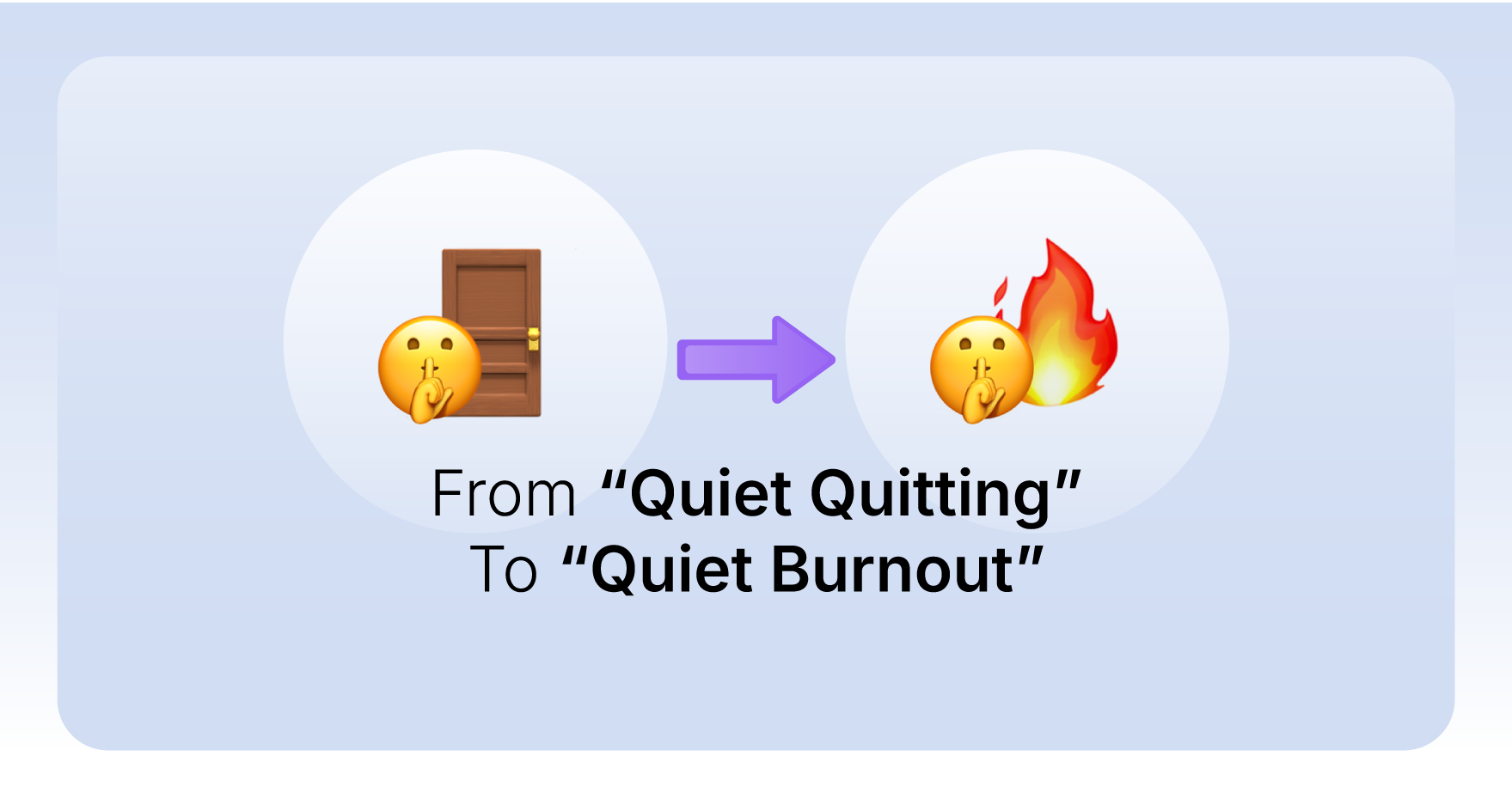
It seems like just yesterday we were all buzzing about Quiet Quitting. The term, which essentially described employees doing the bare minimum required by their job description and nothing more, became a viral sensation. It was a pushback against hustle culture, a movement toward setting healthy work boundaries, and for many, a lifeline.
But as we roll into 2026, the conversation is shifting. The trend hasn't gone away; it's evolved. We're starting to see a new, more concerning phenomenon emerge: Quiet Burnout.
What Happened to Quiet Quitting?
To understand where we are, let's quickly recap. Quiet Quitting wasn't about actually quitting your job; it was about quitting the idea of going above and beyond.
The Quiet Quitting Mindset:
- "I am not my job." Separating self-worth from work performance.
- "No more unpaid labor." Stopping tasks that fall outside the defined scope.
- "Protecting my time." Leaving work on time, every time.
It was, for many, a relatively proactive act of self-preservation. Employees felt a sense of control over their time and energy.
The Rise of 'Quiet Burnout'
If Quiet Quitting was about establishing boundaries, Quiet Burnout is what happens when those boundaries are repeatedly tested, eroded, or simply aren't enough to contain the pressure.
Quiet Burnout is a state of chronic workplace stress that has not been successfully managed, leading to:
- Exhaustion (Physical and Emotional): Feeling drained even after a weekend.
- Cynicism/Detachment: A negative or excessively distant attitude toward the job.
- Reduced Professional Efficacy: A feeling of incompetence and lack of accomplishment.
The "Quiet" part comes in because, unlike the traditional, highly visible burnout that leads to taking a leave or an angry resignation, Quiet Burnout is internalized and hidden.
Why is This Trend Exploding Now? (What People Are Talking About)
The shift from proactive 'quitting' to passive 'burnout' is being driven by several major forces that are dominating workplace discussions in 2026:
- The AI/Efficiency Paradox: Companies are integrating new AI tools and demanding higher efficiency from a stable or shrinking headcount. The promise was "AI will free you up," but the reality often is, "AI lets us double your workload." This drives stress without a corresponding increase in compensation or staff.
- RTO (Return to Office) Pushback: The mandatory or hybrid RTO policies have effectively swallowed the personal time people gained during remote work (the commute, the "office performance"). This loss of control is a massive contributor to stress.
- Perceived Stagnation: Many who quietly quit were hoping to maintain their current role while finding more fulfillment elsewhere. But the global economic and hiring landscape in 2025/2026 has made job mobility difficult. Employees are trapped in roles they've mentally checked out of, leading to deep, festering discontent.
- The 'Productivity Paranoia' Cycle: Managers, fearing quiet quitting, implement intense surveillance and micro-management. This lack of trust is a psychological stressor that dramatically accelerates burnout.
How to Spot the Signs of Quiet Burnout (In Yourself and Others)
Quiet Burnout is insidious because it doesn't look like a dramatic breakdown. It looks like a slow, quiet fade. Here's how to spot it:
|
Sign |
Quiet Quitting (Proactive Boundary) |
Quiet Burnout (Passive Detachment) |
|
Punctuality |
Logs off exactly at 5:00 PM to start personal time. |
Logs on later/leaves earlier due to exhaustion. |
|
Communication |
Sends concise, professional emails strictly related to the task. |
Doesn't reply to emails or replies with extreme, noticeable delay. |
|
Effort |
Produces good work, but nothing extra. |
Produces barely acceptable or mistake-ridden work. |
|
Mood |
Neutral, calm, and slightly detached. |
Irritable, cynical, or completely flat and devoid of energy. |
|
Social |
Attends necessary meetings and company events. |
Actively avoids all social contact (turning off camera, skipping optional team lunches). |
The biggest difference: A quiet quitter is generally content with their boundaries. A quiet burner is miserable and feels powerless.
The Solution: Moving from Quiet to Clear
For both employees and employers, the answer lies in eliminating the 'Quiet' from the equation and moving toward Clear Communication and Active Restructuring.
- For Employees: Stop passively burning out. Initiate a "stay interview" with your manager. Clearly articulate what resources you need, what tasks need to be re-prioritized, and what work/life balance actually looks like for you.
- For Employers: Acknowledge the stress. No amount of office pizza is a substitute for fair compensation, manageable workloads, and psychological safety. Focus on:
- Workload Audits: Honestly assess if AI integration has actually reduced the required human effort.
- True Flex: Offer genuine flexibility in hours and location, not just nominal options.
- Burnout Prevention Programs: Focus on actual stress management, not just wellness apps.
FAQs on Quiet Quitting and Quiet Burnout in 2026
Is Quiet Quitting a bad thing?
Not inherently. Many mental health experts viewed it as a necessary correction to overwork. The original goal was to establish healthy work-life boundaries, which is a positive act. However, if Quiet Quitting is forced due to an impossible workload, it quickly degrades into Quiet Burnout.
What is the difference between Quiet Quitting and Lazy Performance?
- Quiet Quitting is delivering the required expectations and stopping there. The quality of work is typically good enough, but there is no enthusiasm or extra effort.
- Lazy Performance is failing to meet basic expectations. The employee is not performing their fundamental duties and is often seen as a performance issue. Quiet Burnout can lead to Lazy Performance.
How can a manager address Quiet Burnout without making it worse?
The key is empathy and structure, not surveillance.
- Start a non-judgmental conversation: "I've noticed a change in your energy lately. I want to check in and see if we need to adjust your workload or resources."
- Ask about priorities: "If we have to remove one recurring task from your plate this month, which one should it be?"
- Validate their experience: Acknowledge that the work environment is challenging. Trust is the antidote to Quiet Burnout.
Is Quiet Burnout recognized as a medical condition?
The World Health Organization (WHO) classifies Burnout as an "occupational phenomenon," specifically an international classification of diseases (ICD-11) code for problems associated with employment or unemployment. "Quiet Burnout" is a popular term describing a form of burnout, but it is not a separate medical diagnosis.
.jpg)
Amanee Hasan
Amanee Hasan is a Senior Content Strategist at ZenHR, an award-winning and top-rated HR software solution serving organizations across the MENA region. She specializes in SEO, UX writing, copywriting, product marketing, and content covering the latest HR trends, labor laws, HR technology, and the future of work.