Attendance tracking in 2026 has evolved far beyond clock-ins and timesheets. It now plays a direct role in how organizations manage payroll, ensure compliance, and control workforce costs.
Attendance data feeds directly into payroll calculations, determines overtime liabilities, and impacts how accurately companies can forecast labor costs. According to industry estimates, payroll errors can cost businesses between 1% and 8% of their total payroll annually, and attendance inaccuracies are one of the main drivers behind these losses.
Relying on manual tracking or basic tools creates serious operational risks. These include incorrect overtime calculations, employee disputes, inconsistent payroll results, and fragmented reporting across multiple branches or entities. As companies scale beyond 150 employees, even small attendance errors can multiply quickly and become difficult to manage.
At the same time, the way attendance software is evaluated has fundamentally changed. It is no longer just an HR decision. Finance teams are involved to ensure cost accuracy, operations teams rely on it for shift planning, IT teams assess integrations and security, and procurement evaluates vendor stability. This makes attendance software a cross-functional infrastructure decision rather than a simple tool selection.
There is no universally “best” attendance software. The right solution depends on your organization’s regulatory environment, workforce structure, shift complexity, and payroll architecture.
This guide is designed to help you navigate that complexity. Instead of focusing on surface-level features, it evaluates platforms based on infrastructure readiness, compliance alignment, and scalability.
Our Evaluation Framework: How We Assessed Attendance Software
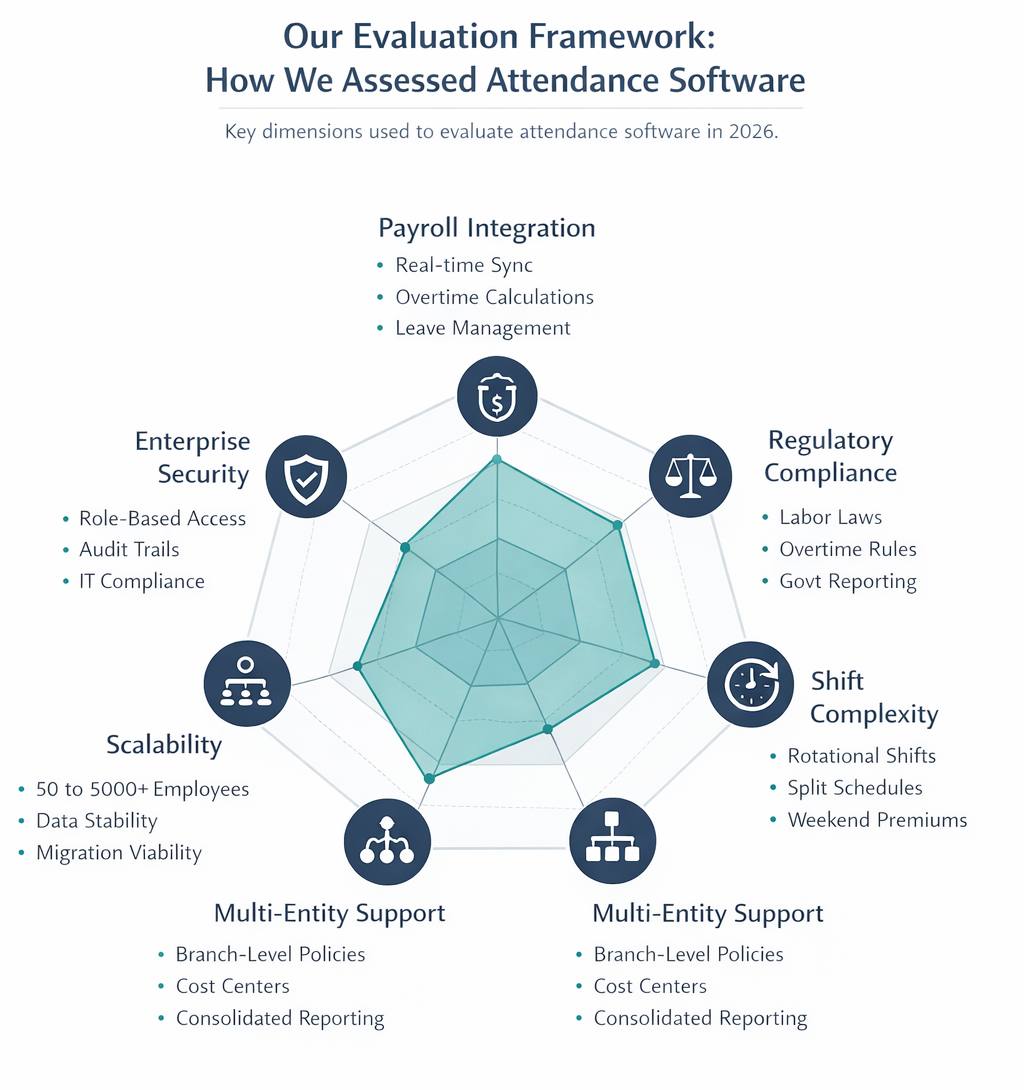
To evaluate attendance software effectively, we focused on the areas that have the greatest operational impact. These include payroll integration, regulatory compliance, shift complexity, scalability, and enterprise governance.
Payroll Integration & Accuracy
Payroll integration is one of the most critical aspects of any attendance system. We looked closely at whether platforms could sync attendance data with payroll in real time, automatically calculate overtime, and handle leave deductions without manual intervention.
Systems that lack strong payroll integration often require HR or finance teams to transfer data manually, which increases the likelihood of errors. In contrast, platforms with automated synchronization significantly reduce discrepancies and improve audit readiness.
Regulatory & Labor Law Alignment
Attendance systems must align with local labor laws to ensure compliance. We assessed how well each platform handles overtime rules, working-hour regulations, public holidays, and government reporting requirements.
This is particularly important in regions with strict labor laws, where non-compliance can result in financial penalties or legal complications.
Shift & Overtime Complexity Handling
Many organizations operate with complex scheduling structures, including rotational shifts, split shifts, night shifts, and variable schedules. We evaluated whether each system could handle these scenarios accurately.
While many tools support basic clock-in and clock-out functionality, fewer systems can manage layered shift logic and exception handling without requiring manual adjustments.
Multi-Branch & Multi-Entity Support
For organizations operating across multiple locations or entities, attendance tracking becomes more complex. We looked at how platforms manage branch-level policies, cost centers, and consolidated reporting.
Systems that support multi-entity operations enable organizations to maintain consistency while still applying localized rules where necessary.
Scalability
Scalability determines whether a system can grow with your organization. We evaluated how platforms perform across different employee sizes, from mid-sized companies to large enterprises.
A system that works well at 50 employees may not perform efficiently at 2,000 employees, especially when processing large volumes of attendance data.
Enterprise Security & Governance
Security and governance are essential for organizations handling sensitive employee data. We assessed role-based access controls, approval workflows, and audit trail visibility.
Platforms with strong governance capabilities provide better control and transparency, which is critical for compliance and internal audits.
Reporting & Workforce Analytics
Attendance data is only valuable if it can be analyzed effectively. We evaluated how platforms provide insights into absenteeism, overtime costs, and workforce productivity.
Advanced reporting capabilities allow decision-makers to identify trends and make more informed operational decisions.
Attendance Software Comparison Table (2026)
|
Platform |
Primary Region |
Ideal Company Size |
Payroll Integration |
Compliance Strength |
Multi-Entity Support |
Shift Complexity Handling |
Best Fit |
|
ZenHR |
MENA / GCC |
250–5000+ |
Native, real-time sync |
Advanced (regional labor laws, WPS, GOSI) |
Strong |
Advanced (rotational, overnight, flexible) |
High-compliance, multi-entity organizations in MENA |
|
Talana |
LATAM / Global |
50–1000+ |
Integrated |
Moderate |
Moderate |
Moderate |
Companies looking for all-in-one HR + attendance |
|
Byte |
Europe |
100–2000 |
Integrated |
Strong (EU-focused) |
Moderate |
Moderate |
Compliance-focused European companies |
|
Attendance Keeper |
Global |
10–200 |
Limited |
Basic |
Limited |
Basic |
Small businesses needing simple tracking |
|
Kelio |
Europe |
100–3000 |
Integrated |
Strong |
Moderate |
Advanced |
Structured industries (healthcare, manufacturing) |
|
ProTime |
Europe |
100–3000+ |
Integrated |
Strong |
Strong |
Advanced |
Complex workforce scheduling environments |
|
Workpay |
Africa |
50–1000 |
Native integration |
Moderate |
Moderate |
Moderate |
Emerging markets, mobile-first teams |
|
SeamlessHR |
Africa / Global |
200–5000+ |
Strong integration |
Strong |
Strong |
Advanced |
Enterprise organizations in Africa |
|
Factorial HR |
Europe / Global |
50–1000 |
Integrated |
Moderate |
Limited |
Basic–Moderate |
SMBs prioritizing usability |
|
PeopleForce |
Europe / Global |
50–1000 |
Integrated |
Moderate |
Moderate |
Moderate |
Growing companies focused on employee experience |
Reviewed: The Best HR Attendance Software in 2026
1. ZenHR
Best for: Mid-market to enterprise organizations in MENA
Website: https://www.zenhr.com
ZenHR offers a comprehensive attendance solution that is tightly integrated with payroll and designed for high-compliance environments. Rather than operating as a standalone tool, its attendance module functions as part of a broader HR infrastructure.
The system captures attendance data in real time and automatically feeds it into payroll calculations. This ensures accurate overtime computation and reduces the need for manual adjustments. ZenHR also supports advanced shift configurations, including flexible, overnight, and rotational schedules, making it suitable for organizations with complex workforce structures.
One of its strongest advantages is its deep alignment with regional labor laws. It supports compliance requirements across MENA markets and integrates with government systems such as GOSI and WPS. Additionally, its multi-branch and multi-entity capabilities allow organizations to manage distributed teams while maintaining centralized oversight.
ZenHR also provides real-time dashboards and reporting tools, giving HR and finance teams full visibility into workforce performance and costs.
While it is highly effective for mid-sized and large organizations, it may be more robust than necessary for very small businesses or companies seeking a lightweight attendance-only solution.
2. Talana
Website: https://www.talana.com
Talana is an all-in-one HR platform that includes attendance tracking as part of its broader workforce management capabilities. It focuses on simplifying HR processes while maintaining visibility into employee attendance and performance.
The platform allows employees to clock in through mobile devices and provides managers with tools to monitor attendance patterns and schedule shifts. It also integrates attendance data with payroll, reducing the need for manual calculations.
Talana is particularly well-suited for organizations that want a unified HR system rather than separate tools for attendance and payroll.
3. Byte
Website: https://www.byte.hr
Byte provides workforce management solutions tailored to organizations in Europe. Its attendance functionality is designed to align with regional labor regulations while offering flexibility in scheduling and reporting.
The platform enables organizations to track employee hours, manage shifts, and generate reports that support payroll and compliance processes. It is particularly useful for companies operating in regulated environments where accuracy and reporting are essential.
4. Attendance Keeper
Website: https://attendancekeeper.com
Attendance Keeper is a straightforward, cloud-based attendance tracking tool. It focuses on simplicity and ease of use, making it accessible for smaller organizations or teams with less complex requirements.
The platform allows employees to record their working hours and provides basic reporting capabilities. While it may not offer advanced features such as deep payroll integration or complex shift handling, it serves as a practical solution for businesses looking for a simple system.
5. Kelio
Website: https://www.kelio.com
Kelio is a workforce management platform with a strong focus on time and attendance. It is widely used in Europe and is known for its ability to handle structured work environments.
The platform supports advanced scheduling, compliance tracking, and biometric integrations. It also provides detailed reporting tools that help organizations monitor workforce performance and ensure adherence to labor regulations.
Kelio is particularly effective in industries such as manufacturing and healthcare, where shift management and compliance are critical.
6. ProTime
Website: https://www.protime.eu
ProTime specializes in time tracking and workforce management solutions. Its attendance system is designed to support organizations with complex scheduling needs and regulatory requirements.
The platform provides tools for tracking working hours, managing shifts, and generating reports that support payroll and compliance processes. It is especially valuable for organizations that require precise control over workforce scheduling.
7. Workpay
Website: https://www.workpay.co
Workpay is an HR and payroll platform built for businesses operating in Africa. Its attendance module integrates directly with payroll, allowing organizations to manage employee time and compensation within a single system.
The platform supports mobile clock-ins, attendance tracking, and reporting, making it suitable for companies with distributed teams. It is particularly useful in emerging markets where mobile-first solutions are essential.
8. SeamlessHR
Website: https://www.seamlesshr.com
SeamlessHR offers an enterprise-grade HR platform with built-in attendance tracking. It is designed for large organizations that require scalability and strong integration capabilities.
The platform allows organizations to track employee attendance, manage shifts, and integrate data with payroll systems. Its reporting tools provide insights into workforce trends and performance, helping organizations make data-driven decisions.
9. Factorial HR
Website: https://factorialhr.com
Factorial HR is a modern HR platform that includes attendance tracking as part of its core offering. It focuses on usability and simplicity while still providing essential functionality.
The platform allows employees to log their working hours, request time off, and view schedules. Managers can monitor attendance and generate reports, making it a good fit for small to mid-sized businesses.
10. PeopleForce
Website: https://peopleforce.io
PeopleForce is an HR platform designed to improve employee experience and operational efficiency. Its attendance features are integrated into a broader system that includes performance management and employee engagement tools.
The platform enables organizations to track attendance, manage leave, and analyze workforce data. It is particularly well-suited for growing companies that value a user-friendly interface and a holistic HR approach.
How to Choose the Right Attendance Software in 2026
Choosing the right attendance software requires a structured approach. Organizations should start by understanding their regulatory environment, including overtime laws, holiday requirements, and reporting obligations.
Next, it’s important to map the organization’s structure. This includes identifying the number of branches, entities, and cost centers, as well as anticipating future growth.
Shift and payroll complexity should also be evaluated carefully. Organizations with rotating schedules, variable pay structures, or cross-border teams need systems that can handle these scenarios without manual intervention.
Finally, integration and security requirements should be considered. This includes evaluating how the system connects with payroll and ERP platforms, as well as ensuring that it meets internal governance standards.
One of the most common mistakes organizations make is choosing software based on user interface alone. While usability is important, it should not come at the expense of compliance, integration, or scalability.
Frequently Asked Questions
What’s the best attendance software for large enterprises?
The best solution depends on the organization’s complexity. Enterprises should prioritize systems with strong payroll integration, compliance capabilities, and scalability.
How important is payroll integration in attendance software?
Payroll integration is essential. It eliminates manual data transfer and reduces the risk of errors.
Can attendance systems handle complex shift structures?
Yes, but only advanced systems can manage layered schedules without manual adjustments.
What should enterprises look for in attendance compliance?
They should look for systems that align with labor laws, automate calculations, and provide audit-ready reporting.
Is biometric integration necessary?
It is not always required, but it improves accuracy and reduces time fraud in larger organizations.
How does attendance software reduce payroll errors?
It automates time tracking and calculations, ensuring that payroll data is accurate and consistent.
Conclusion: Attendance Is Workforce Control Infrastructure
Attendance tracking has become a foundational component of workforce management. It directly affects payroll accuracy, compliance risk, and operational efficiency.
As organizations grow, their requirements become more complex. Multi-entity operations, shift variability, and regulatory obligations all influence the type of system needed.
The key to selecting the right attendance software is to approach the decision strategically. Organizations should evaluate their regulatory exposure, map their operational complexity, and ensure alignment between attendance and payroll systems.
Involving HR, Finance, and IT stakeholders in the decision-making process is essential for long-term success.
.jpg)
Amanee Hasan
Amanee Hasan is a Senior Content Strategist at ZenHR, an award-winning and top-rated HR software solution serving organizations across the MENA region. She specializes in SEO, UX writing, copywriting, product marketing, and content covering the latest HR trends, labor laws, HR technology, and the future of work.