Leave management systems are often treated as basic request-tracking tools. In reality, once your organization crosses 100+ employees, leave management becomes a critical layer of workforce infrastructure.
It directly impacts payroll accuracy, labor law compliance, workforce planning, and employee experience. According to industry research, payroll errors affect nearly 20–30% of businesses annually, and inaccurate leave data is one of the leading causes.
When leave is tracked manually or across disconnected tools, organizations often face inaccurate balances, inconsistent policy enforcement, and compliance risks—especially in regulated markets like the GCC or Europe.
As companies expand across regions, complexity increases. Different jurisdictions introduce statutory entitlements, carryover rules, maternity policies, and public holiday calendars. Without automation, HR teams spend excessive time managing policies instead of focusing on strategy.
This is also why leave software decisions are no longer owned by HR alone. Finance teams evaluate payroll impact. IT teams assess integrations and security. Operations teams care about workforce availability.
There is no universal “best” solution. The right platform depends on your regulatory environment, organizational structure, and policy complexity.
Key Capabilities We Looked For
When evaluating leave management software, the focus shifts from features to operational impact.
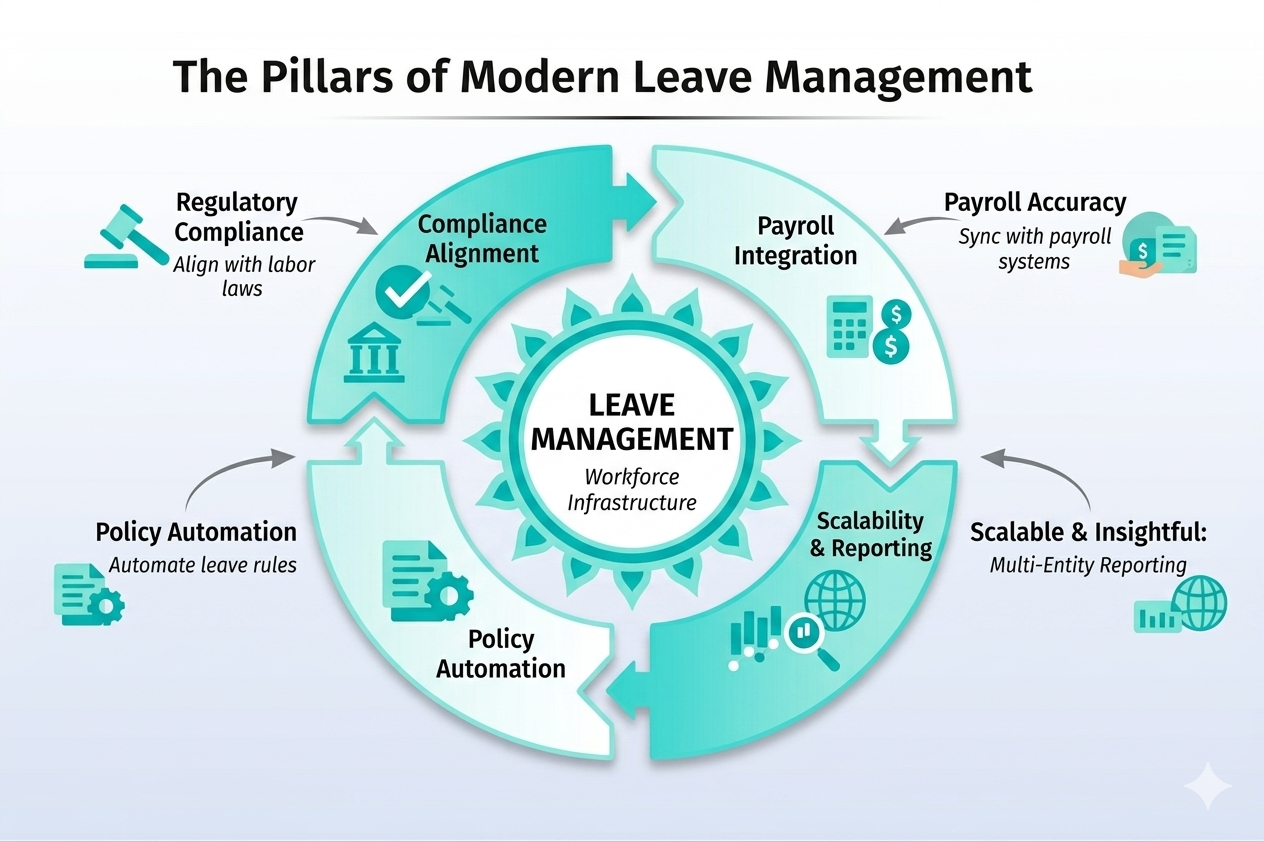
Compliance and Labor Law Alignment
Modern systems must support statutory leave rules, country-specific policies, and public holiday calendars. Without this, organizations risk fines and legal exposure.
Leave Policy and Accrual Automation
High-performing platforms automate accruals, pro-rated allocations, and seniority-based entitlements. Manual systems quickly become unmanageable at scale.
Payroll Integration and Accuracy
Leave directly affects payroll deductions and payouts. Platforms with real-time payroll sync reduce discrepancies and improve audit readiness.
Multi-Entity Governance
Organizations operating across branches or countries need flexible policy control with centralized oversight.
Scalability
A system that works for 50 employees may fail at 500. The ability to handle complexity without increasing admin workload is critical.
Approval Workflows and Permissions
Structured approvals, audit logs, and role-based access ensure governance and control.
Reporting and Workforce Visibility
Modern platforms provide insights into absence trends and workforce availability, helping leadership make better decisions.
What High-Performing Leave Infrastructure Looks Like in 2026
The best systems today function as policy automation engines. They combine compliance logic, payroll integration, and analytics into a single workflow.
Organizations with mature systems typically see fewer payroll errors, reduced admin work, stronger compliance, and improved workforce planning.
The Best Leave Management Software in 2026
1. ZenHR
Homepage: https://www.zenhr.com
Best for: MENA-based mid-market to enterprise companies
ZenHR is built specifically for organizations operating in the GCC and wider MENA region, where labor laws and compliance requirements are complex. Its leave management module is deeply embedded within a broader HR infrastructure, rather than functioning as a standalone tool.
The platform automates leave accruals based on local regulations, including annual leave, sick leave, and maternity policies. It also synchronizes directly with payroll, ensuring that deductions and payouts are calculated accurately without manual intervention.
ZenHR supports multi-entity organizations, allowing different policies across branches while maintaining centralized control. Employees can submit requests through self-service portals, while managers follow structured approval workflows.
Benefits & Features:
Automated accrual calculations aligned with regional laws
Direct payroll synchronization for accurate deductions
Multi-entity policy management
Employee self-service and mobile access
Advanced reporting and workforce insights
2. Vacation Tracker
Homepage: https://vacationtracker.io
Best for: Teams using Slack or Microsoft Teams
Vacation Tracker focuses on simplicity and integration with communication tools. It allows employees to request leave directly through Slack or Teams, making adoption seamless.
The platform handles leave balances, approvals, and reporting while remaining lightweight and easy to use.
Benefits & Features:
Native Slack and Teams integration
Simple leave tracking and approvals
Real-time balance visibility
Calendar synchronization
3. Breathe HR
Homepage: https://www.breathehr.com
Best for: UK SMEs
Breathe HR is designed for small to mid-sized businesses that need a straightforward HR and leave management solution. It provides basic leave tracking, reporting, and employee record management.
Benefits & Features:
Simple leave request workflows
Centralized employee data
Basic reporting tools
User-friendly interface
4. Personio
Homepage: https://www.personio.com
Best for: European mid-market companies
Personio offers strong compliance alignment within Europe and supports localized leave policies. It integrates leave management with payroll and broader HR functions.
Benefits & Features:
EU compliance support
Automated leave accruals
Payroll integration
Workforce analytics
5. Keka
Homepage: https://www.keka.com
Best for: India-based companies
Keka provides robust leave and attendance management integrated with payroll. It is particularly strong in handling complex leave policies and employee engagement.
Benefits & Features:
Advanced leave policy customization
Payroll and attendance integration
Employee self-service
Performance insights
6. Employment Hero
Homepage: https://employmenthero.com
Best for: Australia and UK businesses
Employment Hero combines HR, payroll, and leave management into a unified platform. It supports localized compliance and provides workforce analytics.
Benefits & Features:
Integrated payroll and leave.
Compliance support for AU/UK
Employee self-service
Reporting and analytics
7. Swingvy
Homepage: https://www.swingvy.com
Best for: Southeast Asia startups
Swingvy is designed for growing companies in Asia. It offers leave management alongside payroll and benefits administration.
Benefits & Features:
Localized compliance for Asia
Leave and payroll integration.
Mobile-first experience
Benefits management
8. Factorial HR
Homepage: https://factorialhr.com
Best for: SMBs in Europe and the US
Factorial provides a clean and modern interface with strong leave tracking capabilities. It focuses on usability while still offering automation features.
Benefits & Features:
Automated leave tracking
Time and attendance integration
Employee self-service
Reporting dashboards
9. Rippling
Homepage: https://www.rippling.com
Best for: Companies needing HR + IT integration
Rippling stands out by combining HR, payroll, and IT management. Its leave management capabilities are tightly integrated into its broader platform.
Benefits & Features:
Unified HR and IT system
Automated workflows
Payroll integration
Advanced reporting
10. CharlieHR
Homepage: https://www.charliehr.com
Best for: Small UK businesses
CharlieHR is a lightweight HR platform focused on simplicity. It handles leave requests, onboarding, and basic employee management.
Benefits & Features:
Simple leave tracking
Onboarding tools
Employee records
Basic reporting
Comparison Table
|
Platform |
Region Focus |
Ideal Size |
Compliance Depth |
Payroll Integration |
Multi-Entity Support |
|
ZenHR |
MENA / GCC |
150–5000+ |
Advanced |
Strong |
Strong |
|
Vacation Tracker |
Global |
10–500 |
Basic |
Limited |
Limited |
|
Breathe HR |
UK |
10–200 |
Moderate |
Limited |
Limited |
|
Personio |
Europe |
50–2000 |
Strong |
Strong |
Moderate |
|
Keka |
India |
50–2000 |
Strong |
Strong |
Moderate |
|
Employment Hero |
AU / UK |
50–2000 |
Strong |
Strong |
Moderate |
|
Swingvy |
Asia |
50–1000 |
Moderate |
Strong |
Limited |
|
Factorial |
EU / US |
10–1000 |
Moderate |
Moderate |
Limited |
|
Rippling |
Global |
50–3000 |
Strong |
Strong |
Strong |
|
CharlieHR |
UK |
10–200 |
Basic |
Limited |
Limited |
How to Choose the Right Leave Management Software
Step 1: Define Regulatory Complexity
Start by understanding your legal obligations. This includes statutory leave rules, public holidays, and compliance exposure.
Step 2: Assess Policy Complexity
Evaluate how many leave types you manage and whether policies vary across departments or locations.
Step 3: Evaluate Payroll Impact
Leave affects deductions and payouts. Systems without payroll integration often create errors.
Step 4: Review Governance
Look for structured approval workflows, permissions, and audit logs.
Step 5: Align With Growth
Choose a system that can scale with your organization as policies and headcount increase.
Common Mistakes
Many organizations prioritize UI over functionality, ignore compliance requirements, or underestimate policy complexity. These decisions often lead to costly migrations later.
Frequently Asked Questions
What’s the best leave management software for large organizations?
Platforms like ZenHR, Rippling, and Personio are better suited for larger organizations due to their scalability and compliance capabilities.
How important is payroll integration?
It is critical. Without it, HR and finance teams must manually reconcile leave data, increasing the risk of errors.
Can leave software handle complex accrual policies?
Yes, modern systems automate accruals, pro-rating, and seniority-based entitlements.
How does it support compliance?
By aligning leave policies with local labor laws and automating calculations.
What reporting capabilities should HR expect?
Absence trends, leave balances, workforce availability, and liability forecasting.
How does it improve workforce planning?
By providing visibility into who is available, helping managers plan staffing more effectively.
Leave Management Is Basically Policy Infrastructure
Leave management directly impacts payroll, compliance, and workforce planning. As organizations grow, complexity increases, making manual processes unsustainable.
Modern platforms act as policy automation engines, reducing administrative overhead while improving accuracy and compliance.
To move forward, clarify your regulatory exposure, map your leave policies, and evaluate integration needs. Involve HR, finance, and IT early in the process.
.jpg)
Amanee Hasan
Amanee Hasan is a Senior Content Strategist at ZenHR, an award-winning and top-rated HR software solution serving organizations across the MENA region. She specializes in SEO, UX writing, copywriting, product marketing, and content covering the latest HR trends, labor laws, HR technology, and the future of work.